
Chapter 7
Why do cats usually land on their feet?
A cat slips and falls back-first, yet in a blink it flips over and lands on all four feet. How does it turn?
10 pages · about 5 minutes
Why do cats usually land on their feet?
Chapter 7
A cat slips and falls back-first, yet in a blink it flips over and lands on all four feet. How does it turn?
10 pages · about 5 minutes
Page 1 of 10
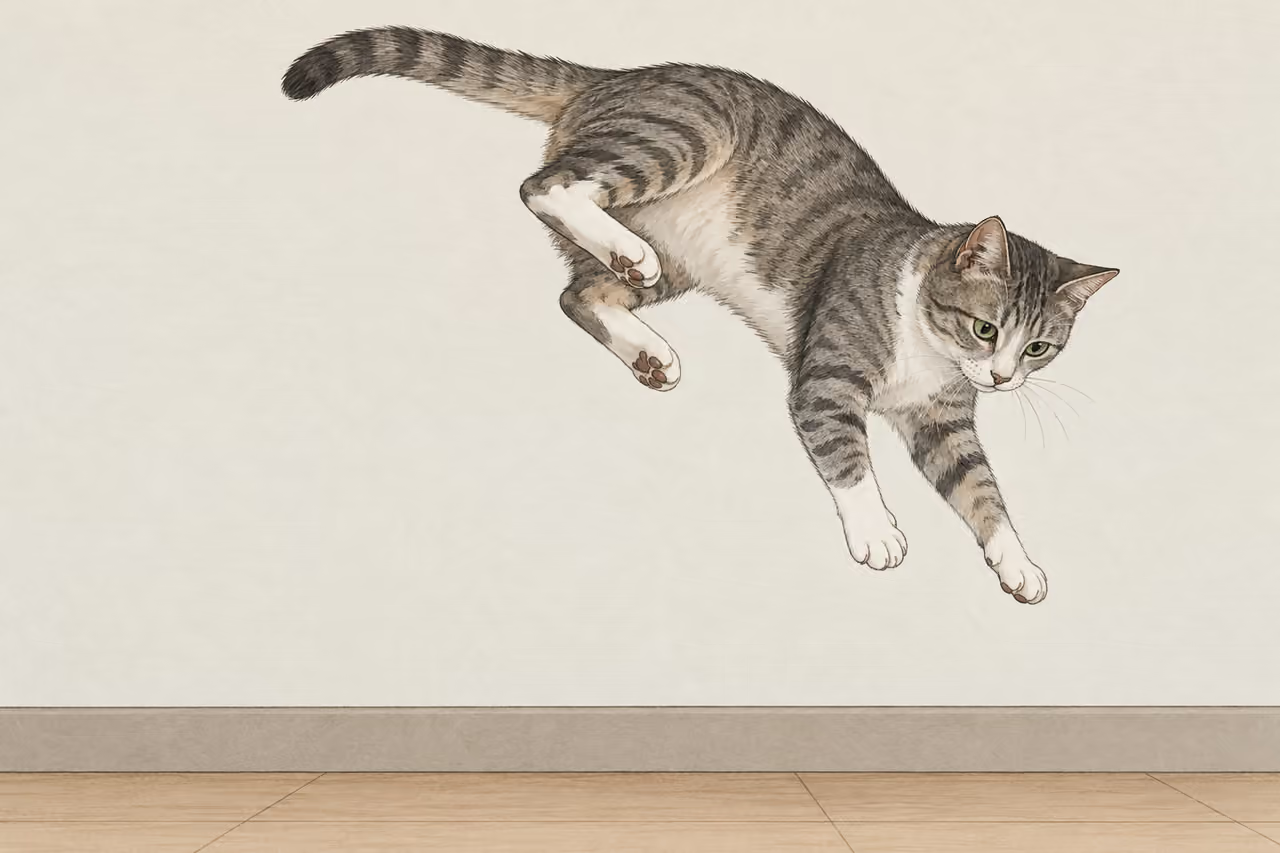
Na's grey cat was asleep on top of the wardrobe. Rolling over in its sleep, it slipped off and fell with its back to the floor. In a blink, it turned over and dropped lightly onto the rug on all four feet.
Cú Bông guessed the cat had kicked against the air, as you kick water when swimming, to flip over.
Dad had Na sit on the swivel chair, lift both feet and twist her body quickly to the left. Strangely, without pushing on anything, the chair turned to the right. Dad added: never drop a cat to try this, because cats can still get hurt.
On a swivel chair, twisting your body left can make the chair turn right, as Na's did. An important part of a cat's turn is bending at the middle and twisting its two halves opposite ways.
A cat can also tuck one pair of legs and stretch the other, helping the two halves turn differently. In 1894, the French scientist Étienne-Jules Marey took a rapid run of photos of a falling cat. They showed the cat start to fall without spinning at all, yet still turn over.
Step through to watch a cat turn over in mid-air. At which step do the cat's front and back halves turn opposite ways?
A key part of a cat's turn is bending in the middle and twisting its two halves opposite ways. That is how it turns over even though it starts to fall without spinning.
Everything this chapter tells you rests on at least two trustworthy sources, retold in the book's own words.
Cú Bông's books are open to everyone who signs in: read page by page like a paper book, with a small experiment right on the page.
All it takes is a Google account — no new password.