
Chapter 5
How does a spider build a round web?
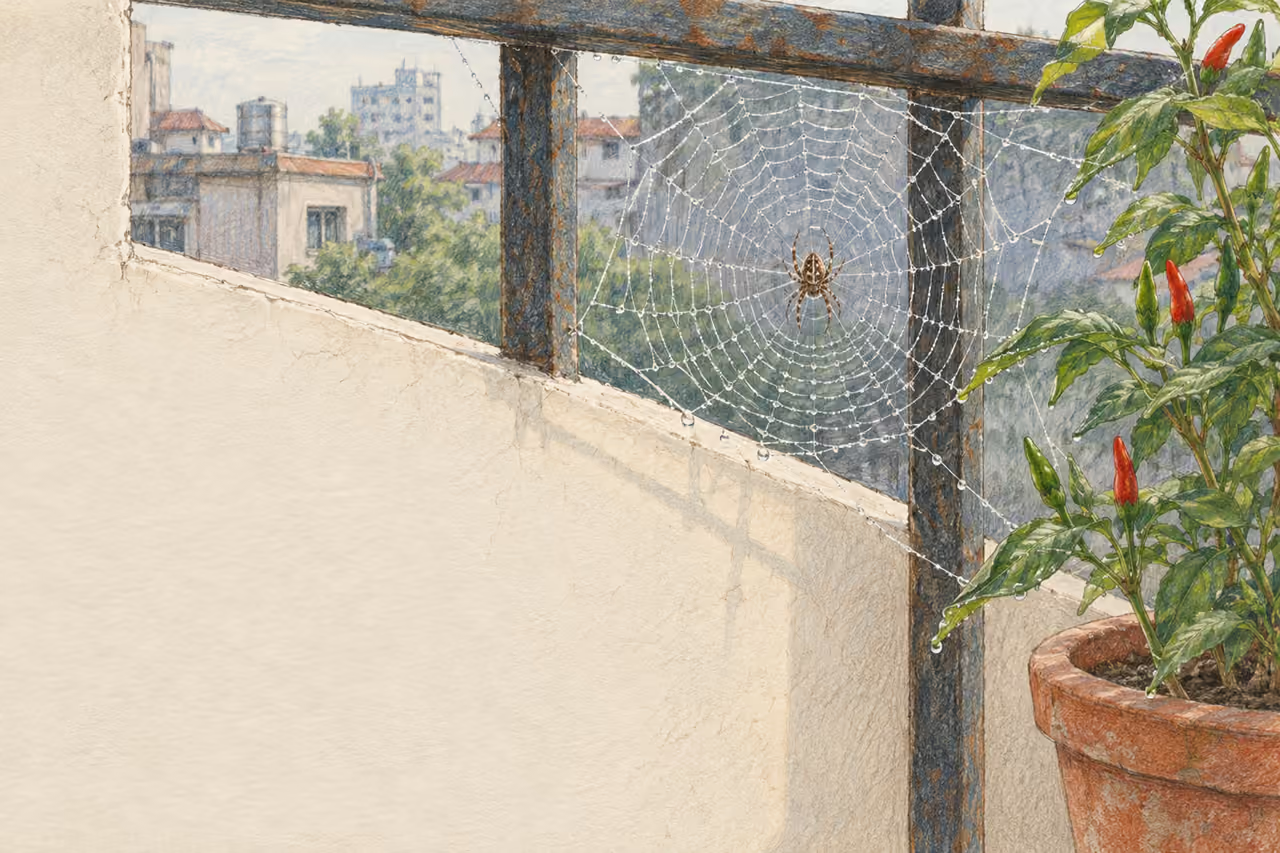
One morning, a round web beaded with dew hangs between the chilli plant and the railing. How did one tiny spider make it?
10 pages · about 5 minutes
How does a spider build a round web?
Chapter 5
One morning, a round web beaded with dew hangs between the chilli plant and the railing. How did one tiny spider make it?
10 pages · about 5 minutes
Page 1 of 10
On Na's balcony, a pot of chilli stands a hand's span from the railing. Last night there was nothing, yet this morning a neat round web joined the two.
Cú Bông guessed the spider had leapt from the chilli plant to the railing. Then it jumped back and forth, weaving the web as it went.
The next day, Na got up very early to watch. The spider sat on the chilli and let out a fine thread; a breeze carried it to the railing. Then it crawled back and forth along that thread, without a single jump.
An orb-weaver often starts with a thread that drifts on the breeze and catches on a support: a bridge. It crawls across, adding more silk to make the bridge stronger. Then it drops a thread from the middle and fixes it below: a Y, whose centre becomes the hub.
From the hub, the spider stretches many spokes outwards. It lays a widely spaced spiral from the hub outwards to hold on to for now. Then it works back inwards, laying a closer spiral of sticky silk.
Step through to watch a round web take shape. At which step does the sticky silk appear?
An orb-weaver starts with a bridge thread, then a Y, then spokes, and last of all a sticky spiral. Only the spiral is sticky; the spider moves about on the threads that aren't.
Everything this chapter tells you rests on at least two trustworthy sources, retold in the book's own words.
Cú Bông's books are open to everyone who signs in: read page by page like a paper book, with a small experiment right on the page.
All it takes is a Google account — no new password.