
Chapter 3
Where does well water come from?
It had not rained for days, yet Grandma's tube well still pumped up cool water. Where does well water come from?
10 pages · about 5 minutes
Where does well water come from?
Chapter 3
It had not rained for days, yet Grandma's tube well still pumped up cool water. Where does well water come from?
10 pages · about 5 minutes
Page 1 of 10
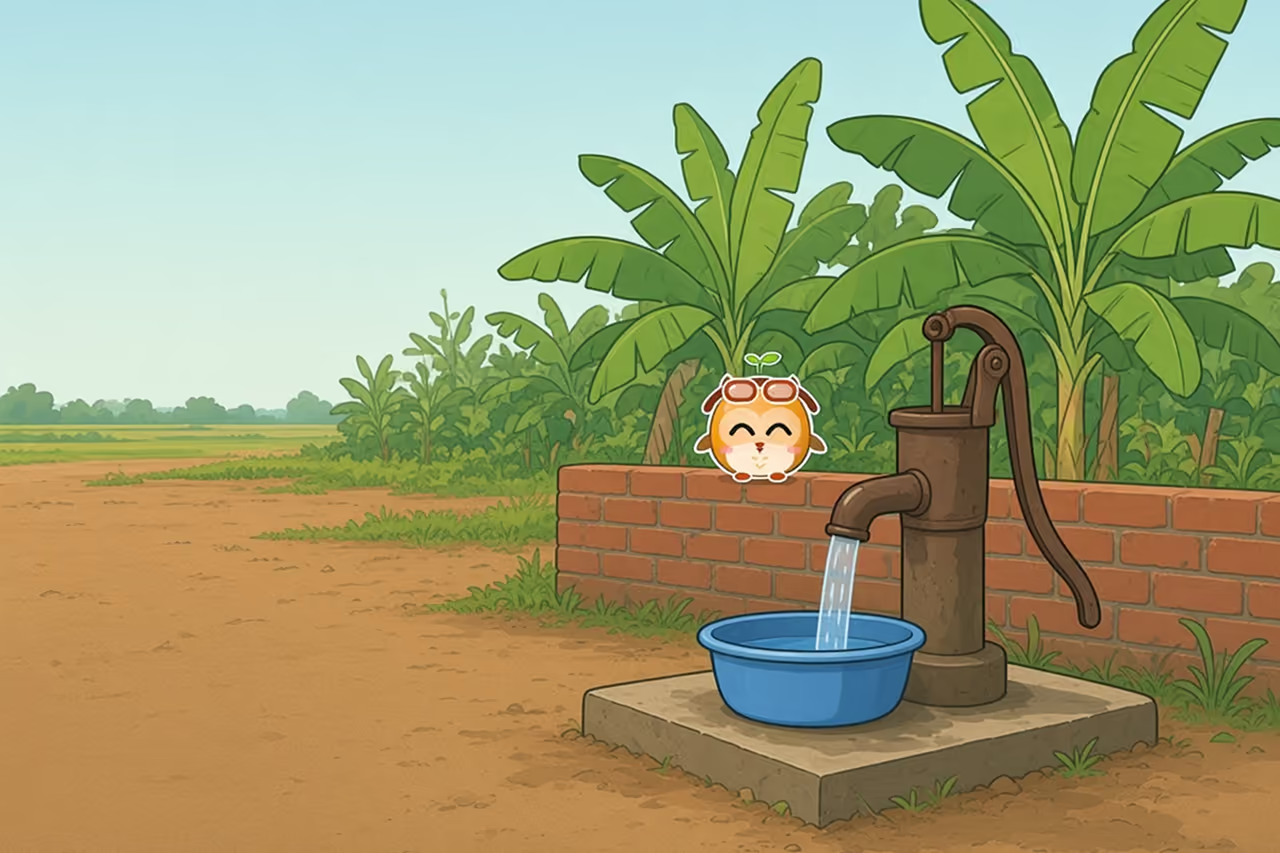
On her summer stay in the countryside, Na went to the hand pump every morning to wash her face. Each push of the handle sent cool water gushing into the basin, though it had been dry all week.
All that dry week the water kept coming, cool, so Cú Bông guessed a big lake lay under the yard. That afternoon, Grandpa dug a deep hole for a banana plant, and Cú Bông perched at its edge to watch.
The deeper the hole, the wetter the soil, until water seeped into the bottom from the sand around it. There was no lake at all: the water came out of the sandy soil itself. So how does water stay in the ground?
Rain soaks down through soil whose spaces still hold both air and water. Deeper, above a tight layer such as clay, it collects until every gap in sand and rock is full.
The top of the layer where every space is full of water is called the water table. A tube well is a pipe sunk below the water table. Water seeps into the pipe from the spaces in the ground around it, and the pump draws it up.
Step through a model: a box with clay at the bottom, dry sand above and a tube in the sand. Where does the water in the tube come from?
Rain soaks into the ground and fills the spaces between sand, gravel and rock deep down. A well is a pipe sunk below the water table: water seeps in and is pumped up.
Everything this chapter tells you rests on at least two trustworthy sources, retold in the book's own words.
Cú Bông's books are open to everyone who signs in: read page by page like a paper book, with a small experiment right on the page.
All it takes is a Google account — no new password.