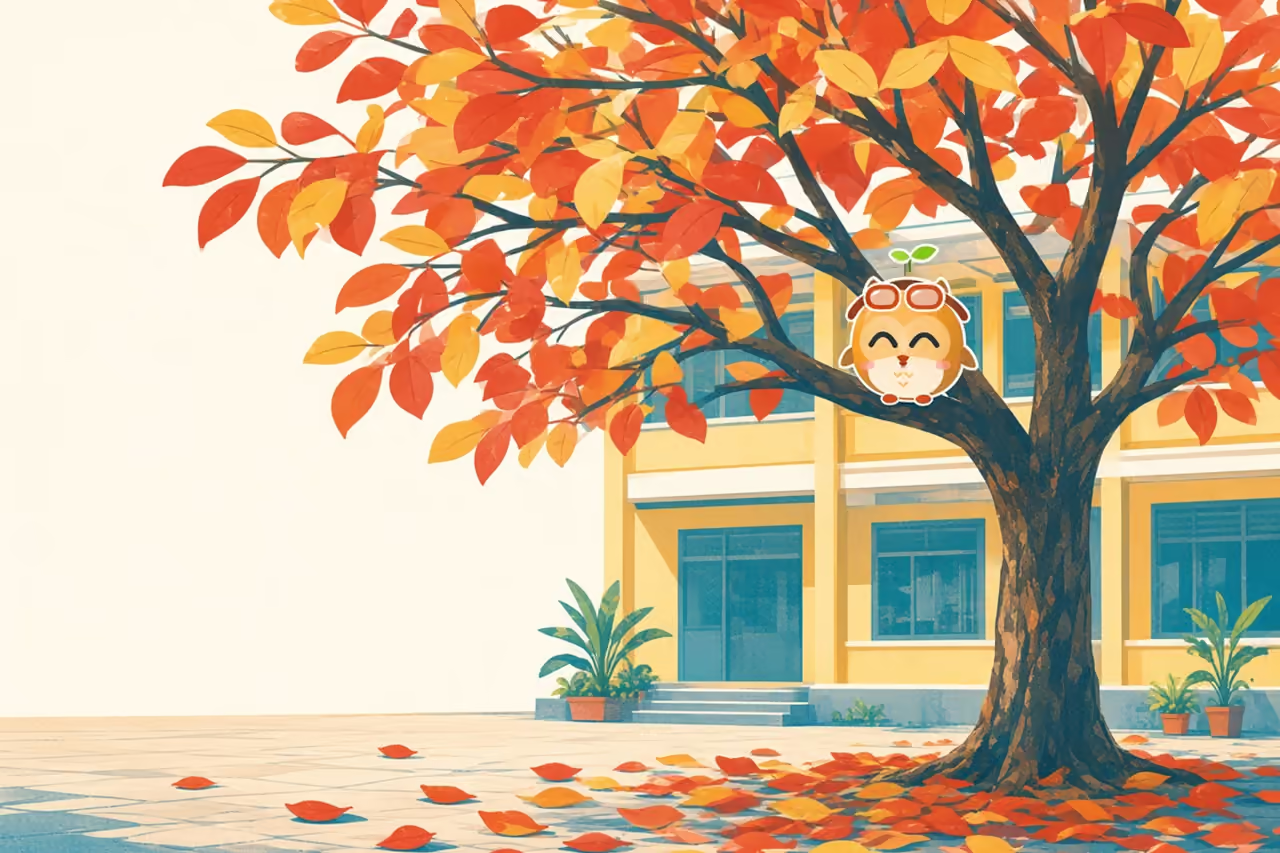
In winter, the schoolyard's tropical almond turned yellow, then red, until its whole canopy was red. Every morning, the caretaker swept up big red leaves, each larger than a hand.
Cú Bông guessed the summer sun had scorched the leaves red, dried them out, and made them fall. But it was winter now, cool, with only a pale, gentle sun.
Na picked up a leaf that had just fallen: bright red, yet thick and soft, and it folded without crumbling. It was not dried or burnt at all, so where did the red come from?
As the days grow shorter and the weather colder, the chlorophyll in the leaf breaks down. As the green fades, the yellow that was in the leaf all along shows through. The leaf also makes a new colouring that looks red, so the tropical almond turns bright red.
Where the leaf stalk joins the twig, a thin, weak layer forms. That layer cuts the leaf loose, until the wind blows it off. The tropical almond sheds its leaves, and for a while it stands almost bare.
Step through four pictures to follow one tropical almond leaf from green to falling. How does it change colour before it falls?
- Where the leaf comes away, the tree seals the wound, leaving a small scar on the twig.
Before it falls, the leaf's chlorophyll breaks down, its yellow shows, then it makes a red colouring. A thin layer at the stalk cuts it loose, and the wind blows it down.