
Chapter 4
Why do roots grow down and stems grow up?
Whether a seed lies face up or on its side, its root still grows down and its stem grows up. Why do roots grow down and stems grow up?
10 pages · about 5 minutes
Why do roots grow down and stems grow up?
Chapter 4
Whether a seed lies face up or on its side, its root still grows down and its stem grows up. Why do roots grow down and stems grow up?
10 pages · about 5 minutes
Page 1 of 10
At school, the teacher had everyone plant a bean in a clear cup of damp cotton wool. Once its white root grew down and its shoot grew up, Na took the cup home to her windowsill.
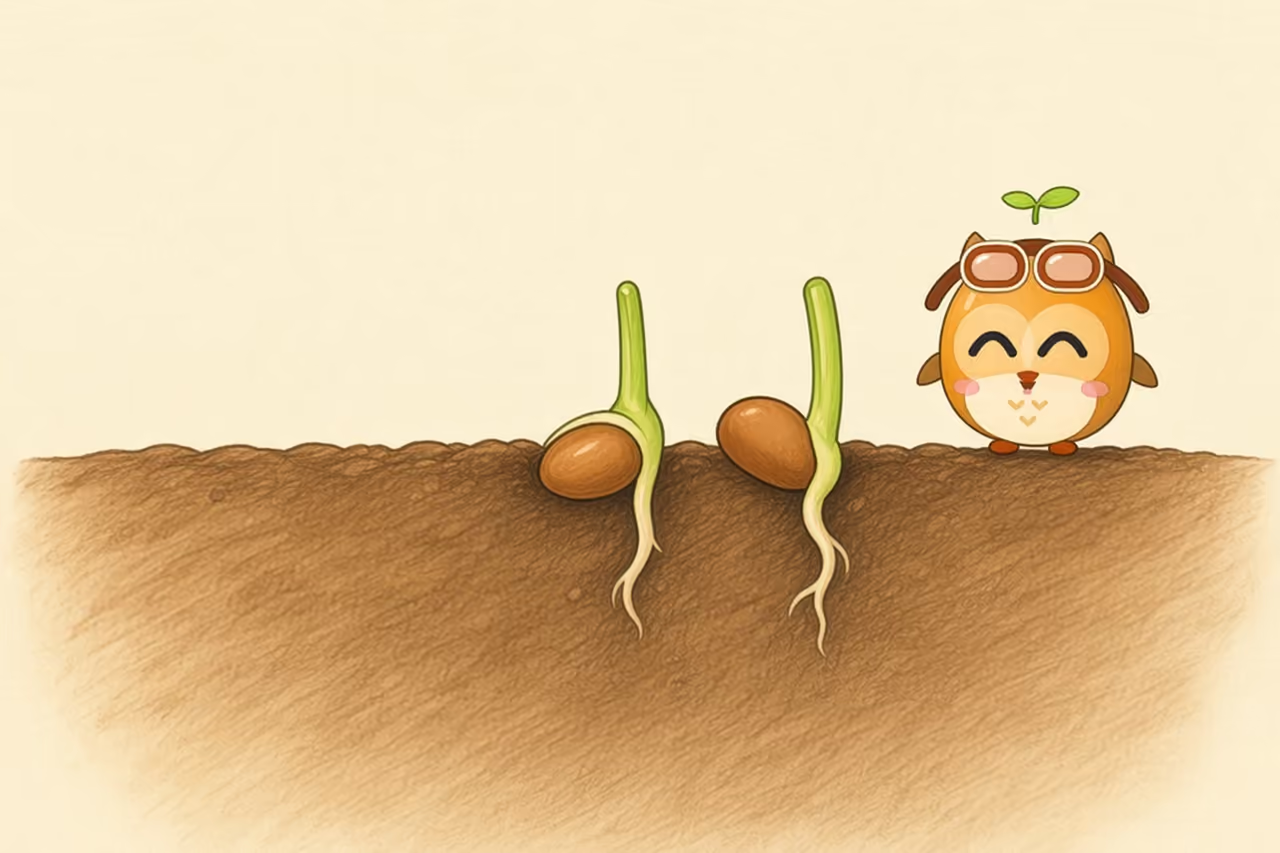
That night the wind blew in, and the cup tipped over onto its side. By morning, the tip of the root had curved down and the shoot tip had curved up. Cú Bông guessed the root was heavy and hung down, like a loose string.
Na looked closely: the older part of the root still lay sideways, and only its tip had curved down. And the shoot had not drooped at all; it had lifted itself up. So how do roots and stems know which way to grow?
A plant can sense the pull towards the ground, called gravity. In general, a plant's stem grows upwards and its roots grow downwards. Turned on its side, a plant changes the way its root and stem grow.
A root or stem bends because one side of it grows longer faster than the other. The root tip curves down and the shoot tip curves up: that is how they bend to gravity.
Step through three pictures of Na's bean cup, from standing upright to the next morning. Which way do the root tip and the shoot tip curve?
A plant senses gravity; in general its roots grow down and its stem grows up. On its side, the root and stem change the way they grow: one side grows longer faster than the other.
Everything this chapter tells you rests on at least two trustworthy sources, retold in the book's own words.
Cú Bông's books are open to everyone who signs in: read page by page like a paper book, with a small experiment right on the page.
All it takes is a Google account — no new password.